|
Data Warehouse BasicsWhat’s a Data Warehouse? Why do they exist? How are they used? What are the data warehouse basics? Here are the data warehouse basics: Data warehousing is a key technology on the way to establishing business intelligence. A data warehouse definition is: A data warehouse is a collection of data extracted from the operational or transactional systems in a business, transformed to clean up any inconsistencies in identification coding and definition, and then arranged to support rapid reporting and analysis.
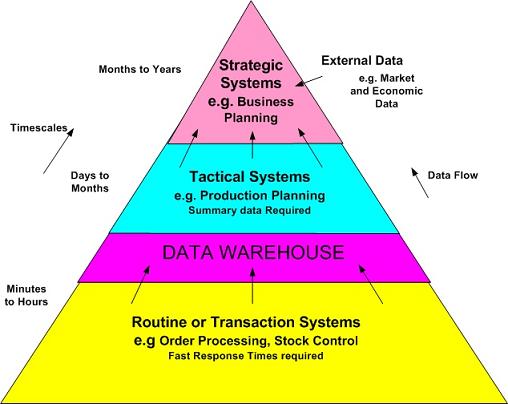
A quick answer would be to support your business strategy and information dashboards monitoring the progress of your business goals with fast and up to date information from disparate sources. But let's first look at how data and systems are typically organised in a business.First is the transactional or routine systems in a business which are designed to support fast data entry and retrieval of the basic information to progress the day to day, hour by hour work of the company. They are not usually designed to produce in depth analysis and consolidation reports. A business or organization has usually three levels of Activities:
See the following diagram which shows these systems, time frames, data flows and where a data warehouse would fit in.
There are a few more reasons why a data warehouse should exist:
Most data warehouses are built using database management software systems with the internal data structure of a warehouse usually taking two forms - star or snowflake This concludes this brief summary of data warehouse basics. Remember to Click here to view the video on Tableau Software
How to Extract, Transform and Load (ETL) your data How to Structure your Data Warehouse - How to Succeed at Data Warehouse Project Management |